This course builds on awareness training and equips responders who may need to work in, or wading through, water, to safely perform non-buoyant rescue operations under the DEFRA Flood Rescue Concept of Operations.
Who should attend
- Personnel who work in or near floodwater, rivers, or watercourses where entering the water (wading) may be required.
- Organizations that require teams capable of performing first response water rescue duties (non-buoyant) but not rescue swimming or using powered or floating craft for rescue.
- Local authority staff, emergency responders, environmental agencies, infrastructure/utility teams, flood risk management staff.
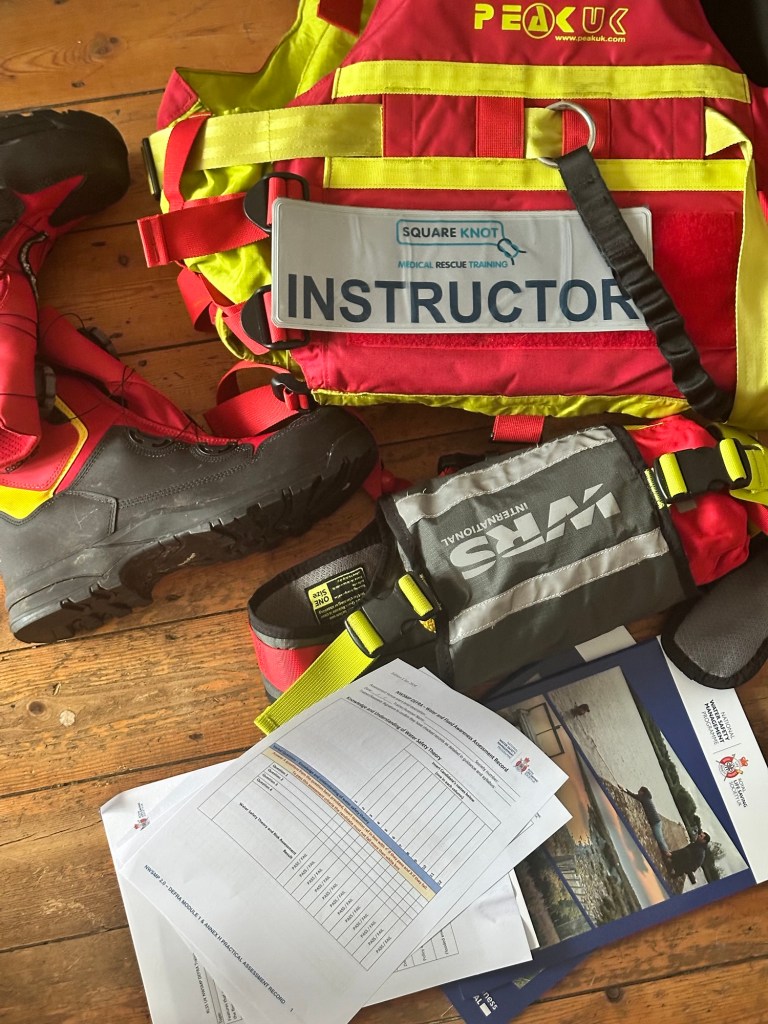
What the course covers
The course combines classroom theory with highly practical sessions. Key content includes:
| Theory / Classroom | Practical / Skills |
|---|---|
| • Dynamic risk assessment in water rescue scenarios | • Safe wading in shallow/moving water, shallow water crossings |
| • Incident management: roles, communications, zoning and scene organisation | • Use of bank-based rescue techniques (shout, reach, throw, wade) |
| • Hydrology: recognising water features, flow, hazards (debris, entrapment, unstable banks) | • Self-rescue techniques: recovering balance, exiting water, recovering from unplanned immersion |
| • Use, maintenance, and limitations of relevant PPE and aquatic safety equipment | • Movement over unstable surfaces (mud, ice, silt), working with sleds as evacuation devices during wading |
| • Search procedures appropriate to water/flood environment | • Scenario-based skills: casualty management, extrication from shallow water, safe shore-side rescues |
Learning outcomes
On successful completion of the course, delegates will be able to:
- Assess hazards around water and flooding, and understand the hydrology, flow, and features that affect safety.
- Apply dynamic risk assessment at water incidents.
- Understand their role and responsibilities within the incident management structure (communication, team roles, safety).
- Use appropriate PPE and aquatic equipment correctly, and know their limitations.
- Perform bank-based rescue methods and limited in-water, non-buoyant rescue: wading, shouting, reaching, throwing, shallow crossings.
- Move safely across challenging surfaces: mud, ice, silt, debris, unstable banks.
- Manage casualties in shallow water settings, including safe evacuation.
Course details
- Duration: 2 days (mix of classroom + practical).
- Prerequisites: Must be physically fit; ability to swim may be required depending on how deep or moving water is used in practical work.
- Age requirement: Typically 18+ (or as per your policy).
- Certification validity: Valid for 3 years; refresher or reassessment recommended.
- Assessment: Continuous assessment during practical tasks and scenarios. Theory checks (quiz or short written exam), plus demonstration of practical skills.
Why this course matters
Floods and water incidents carry high risk—not just from drowning or immersion, but from hazards like cold water effects, unstable ground, debris, entrapment, and unpredictable currents. Responders who may enter the water need the right training, tools, and awareness to protect themselves, support their team, and preserve life. Module 2 First Responder ensures you are equipped to do that safely and effectively.


 Square Knot